Data Storytelling Assistant with Gemini for Slides
Collaborating with Google Slides to build an assistant for students to tell their data stories.
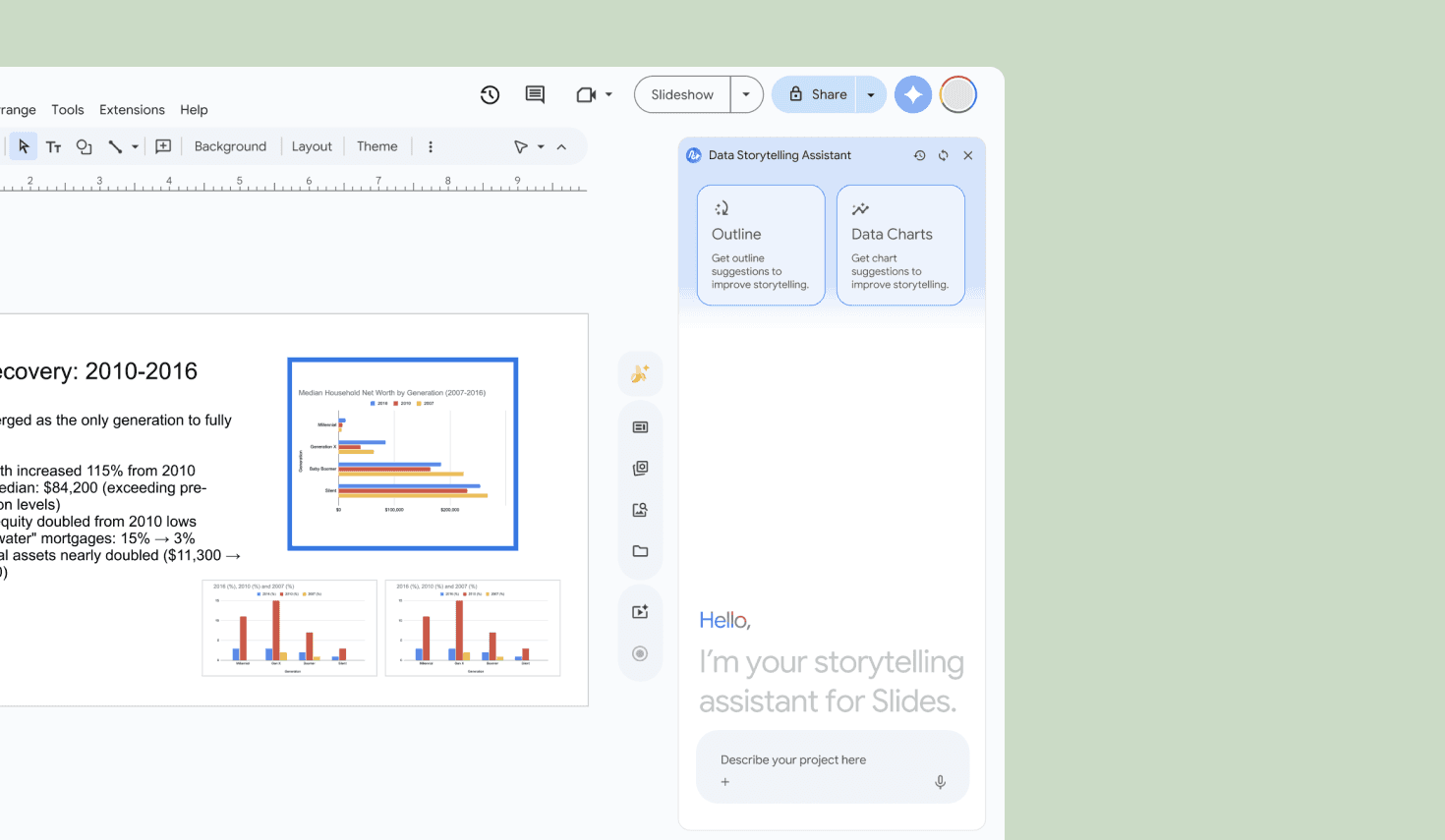
Name of client blurred out due to NDA restrictions
Impact & Outcome
I led the design of new tourist incentive features in an all-encompassing app for the 2026 FIFA World Cup, now being rolled out in MARTA's latest app.
• Taking the lead as a UX designer in a team of 4, our solution unified trip planning, ticketing, and event discovery in one accessible platform — encouraging visitors to choose MARTA over rideshare or private transit.
• The app reduced confusion, improved discoverability of nearby events, and offered seamless, app-free access, helping MARTA prepare for one of its largest international audiences.
Design Highlights
We envisioned MARTA’s Progressive Web Application as a “city companion” — not just a trip planner.
The experience was built around three goals:
Gauge-based visual hierarchy: Managers can instantly gauge store “health” at a glance, then dive deeper as needed.
View the overall health of store and hover over charts to learn more.
Click on cards to get an expanded view with further details.
Overall Outcome:
• Deployed across 100+ stores
• 80% reduction in review time
• Unified data visualization for operational decisions
Project Details
Company: Metropolitan Atlanta Rapid Transit Authority | Team: 2 UX Researchers + 2 UX Designers
Role: UX Design Lead and Researcher | Timeline: Aug 2024 - Dec 2024
Tools: Figma, Qualtrics
Problem Statement
“ How might we incentivize and encourage MARTA use during the 2026 FIFA World Cup? ”
Here's how I approached this challenge as a :
Product Designer
Systems Thinker
Problem-Solver
Framing the Challenge — Thinking in Systems
Users want a stress-free journey to travel around and explore Atlanta—from tickets to destination.
We started off by having discussions with the team at MARTA about the current scenario and past experiences with large events like concerts and the Atlanta Olympics.
Hearing their perspective, we also conducted some preliminary research (including literature review, data analysis and ad-hoc UX analysis of existing apps) to inform us of our primary target user groups and stakeholders who we identified to include the following.
Based on this, we established key research questions where we seeked to understand
• The behavior of potential world cup spectators,
• How they would choose between different modes of transit, and
• Their behaviour when travelling across cities both familiar and unfamiliar to them.
Understanding the Users
Users want a stress-free journey to travel around and explore Atlanta—from tickets to destination.
We started off by having discussions with the team at MARTA about the current scenario and past experiences with large events like concerts and the Atlanta Olympics.
Hearing their perspective, we also conducted some preliminary research (including literature review, data analysis and ad-hoc UX analysis of existing apps) to inform us of our primary target user groups and stakeholders who we identified to include the following.
Based on this, we established key research questions where we seeked to understand
• The behavior of potential world cup spectators,
• How they would choose between different modes of transit, and
• Their behaviour when travelling across cities both familiar and unfamiliar to them.
Framing the Challenge — Thinking in Systems
Users want a stress-free journey to travel around and explore Atlanta—from tickets to destination.
We started off by having discussions with the team at MARTA about the current scenario and past experiences with large events like concerts and the Atlanta Olympics.
Hearing their perspective, we also conducted some preliminary research (including literature review, data analysis and ad-hoc UX analysis of existing apps) to inform us of our primary target user groups and stakeholders who we identified to include the following.
Based on this, we established key research questions where we seeked to understand
• The behavior of potential world cup spectators,
• How they would choose between different modes of transit, and
• Their behaviour when travelling across cities both familiar and unfamiliar to them.
Design & Iteration - Balancing Usability and Feasibility
• Design and engineering ran in parallel, with weekly stand-ups to keep decisions grounded in feasibility.
• Managers were drawn to the gauge meter concept — it needed to be front and center, yet supported by detailed charts.
• After five iterations and 14 screen designs, I refined the hierarchy to make the gauge the focal point while simplifying supporting data visuals.
• Each iteration was validated through feedback loops with client managers to ensure alignment with real workflows.
Reflection
• Design and engineering ran in parallel, with weekly stand-ups to keep decisions grounded in feasibility.
• Managers were drawn to the gauge meter concept — it needed to be front and center, yet supported by detailed charts.
• After five iterations and 14 screen designs, I refined the hierarchy to make the gauge the focal point while simplifying supporting data visuals.
• Each iteration was validated through feedback loops with client managers to ensure alignment with real workflows.