Centralized Resource Hub for Atlanta Pride
Led the design of a digital hub empowering Atlanta's LGBTQ+ community
NOW LIVE on the official Atlanta Pride site
PROJECT DETAILS
Company
Atlanta Pride
Team
UX Designer, UX Researcher
Timeline
Jan 2025 - May 2025
Role
Product Design Lead, Project Manager & UX Researcher
Tools
Figma, Qualtrics, UseBerry
THE CHALLENGE
Atlanta Pride has resources. A LOT OF IT. But currently, there is no visibility or structured manner for people to look for them.
Atlanta Pride supports a large and diverse LGBTQ+ community across Georgia, providing access to resources related to housing, healthcare, advocacy, safety and even events. However, these resources are fragmented across PDFs, internal documents, contacts and social media, often shared manually or only if someone knew to ask from the Atlanta Pride team.
For a community shaped by intersectionality, trust, and safety, this gatekept model created barriers especially for individuals seeking help discreetly or navigating multiple identities.
Therefore, we set out on a journey to answer the following problem statement:
How might we make Atlanta Pride’s resources visible and accessible in a way that is reflective of the community’s lived experiences and intuitive to them?
THE VALUE I DELIVERED
I led UX design and research efforts to build a centralized digital hub allowing resources to be visible for users across Georgia.
For the system
Replaced manual sharing with a scalable, self-serve information architecture.
For the organization
Delivered a high-fidelity prototype adopted by the development team.
For the users

Simplified resource discovery, removing insider barriers & enabling inclusive, intuitive access to support.
THE SOLUTION
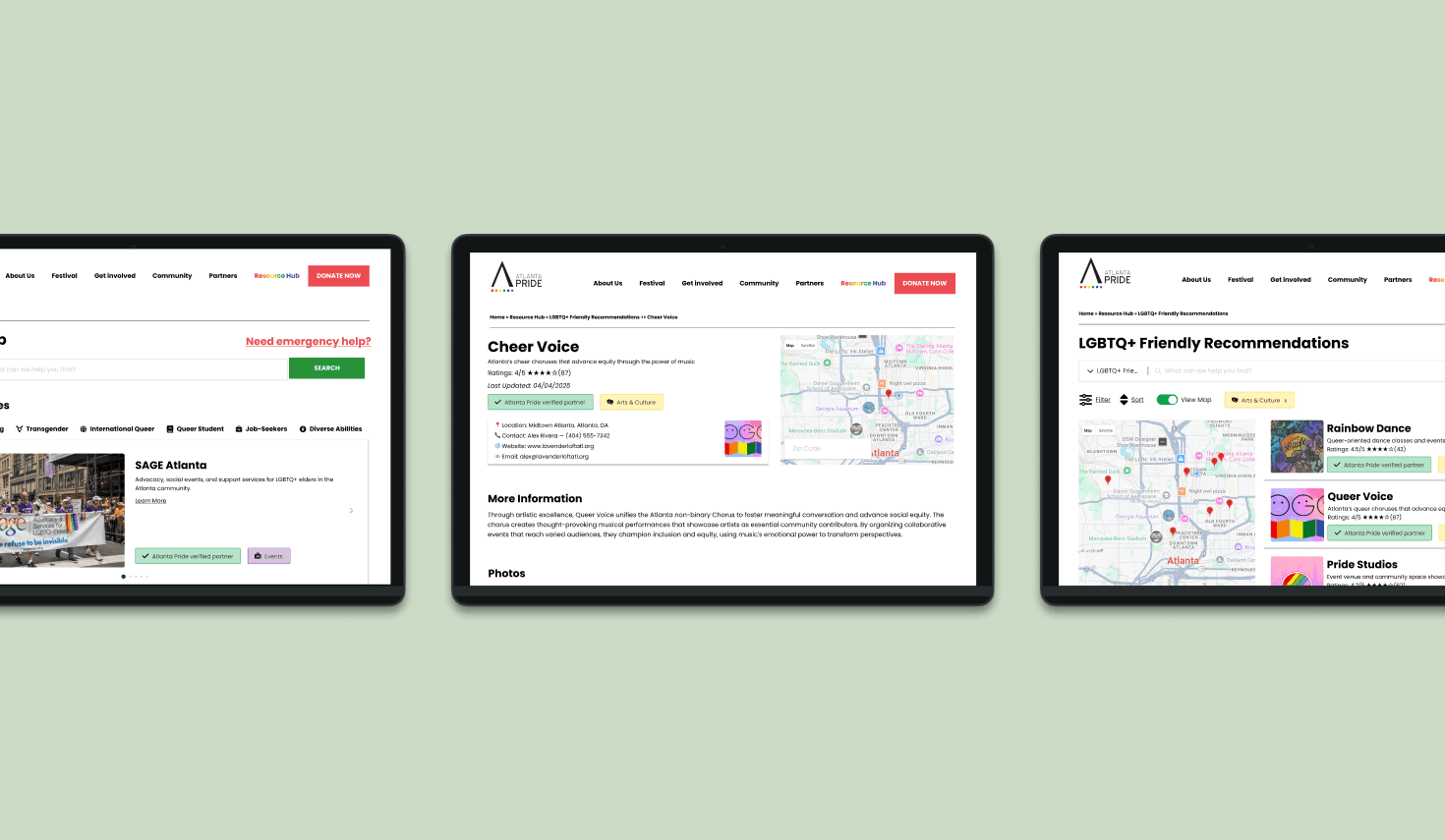
Look for resources by using filters, typing it in, or browsing through featured resources categorized by community types.
Scroll through a list of resources and customize search with a comprehensive set of filters. See how far away a resource is from you. Subscribe to alerts for resource categories to be notified when new ones are added to them.
See a detailed description of the resource. Look at reviews and see if it is by someone similar to you. Compare between two resources.
THE DEEP DIVE
Here’s how I hatched the solution
FRAMING THE CHALLENGE
Atlanta Pride opens its gates to the community but needs a way to make its available resources known to them as well.
To ground the project in institutional reality, our team interviewed Atlanta Pride leadership to map their existing support landscape. We identified that while the organization serves as a critical "entry point" for users into the community but resources like healthcare, housing, and advocacy, lacked a streamlined way for them to be made discoverable to the community.
This session allowed me to define our core Problem Statement: How Might We enhance VISIBILITY and ACCESS to the resources Atlanta Pride currently has?
I was also able to set out the research questions outlined below that we aimed to answer.
Research Questions

How do DIVERSE BACKGROUNDS and LIVED EXPERIENCES of LGBTQ+ individuals influence their resource-seeking behaviors?
What are MOST NEEDED resources and main CHALLENGES users face when trying to find them?


What are the CURRENT PRACTICES that these individuals carry out to find resources?
What FACTORS are important to users when evaluating online resources?

What are ways to improve EXPERIENCE of individuals interacting with Atlanta Pride when finding resources?
We then kicked off our research journey by diving into the secondary research!
SECONDARY RESEARCH
Preliminary research allowed us to identify participatory design process, resource categories and user expectations for the hub.
To orient ourselves toward global best practices, we conducted a literature review that fundamentally shifted our design strategy which was to engage heavily in participatory design.


I also conducted a social media analysis by scraping through Reddit and Facebook posts to see the most sought-after resources as well as what users expect to see.
Finally, just to preface our user research and design journey, we studied other resource hubs to see what users typically expect to see.
+
Learn more about my secondary research
PRIMARY RESEARCH
Facilitating interviews, I understood that there needs to be a focus on intersectional needs and creating a safe space for users.
To move from assumptions to facts, I led the design and deployment of our mixed-methods survey, where we found that users valued inclusivity, reliability and safety while assessing resources. We also identified groups within this diverse community to probe deeper to find their unique needs by heat maps that I created.
The Young Adult

Intersectionality

The Older Adult

Therefore, we intentionally chose interviewees that belonged to either of these groups.
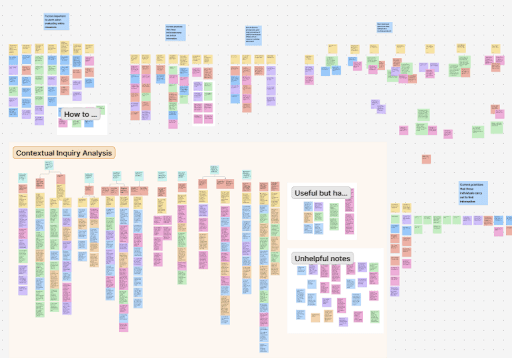
All of these findings allowed us to identify design implications
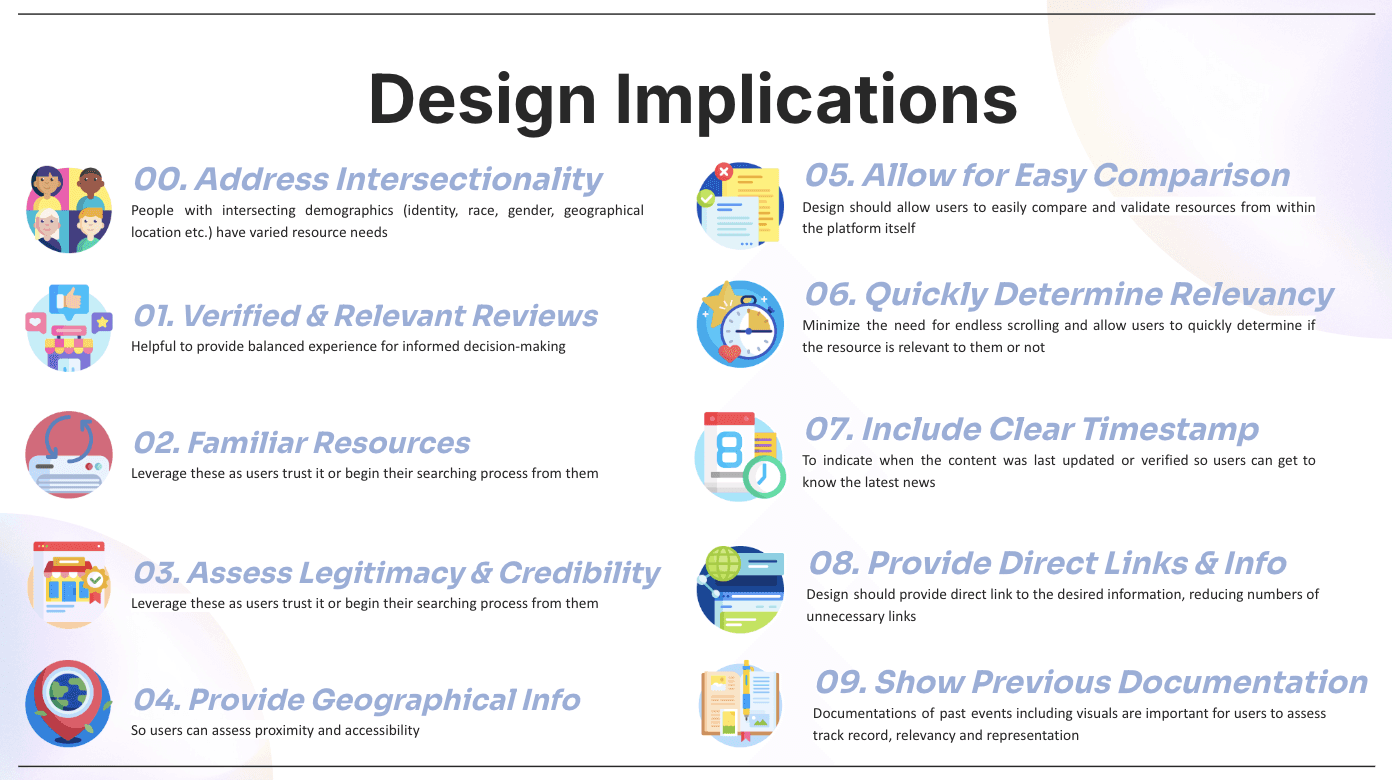
DESIGNING THE SOLUTION
Building the IA, validating it and hosting co-ideation sessions, I led the design of the hub that addresses intersectionality and offers trust designing for the users with the users.
Open Card Sorting Session
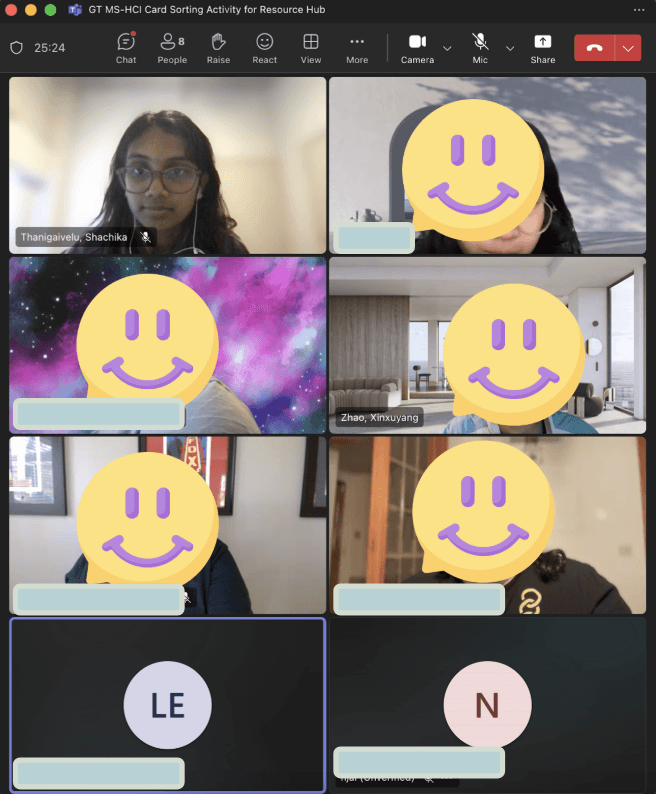
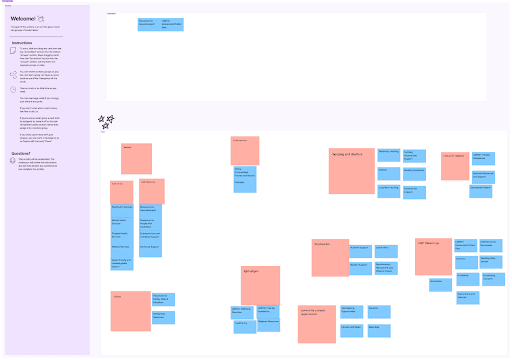
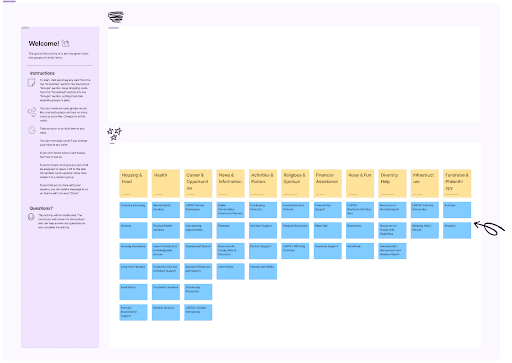
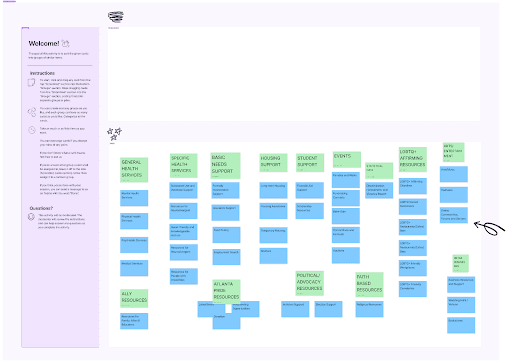
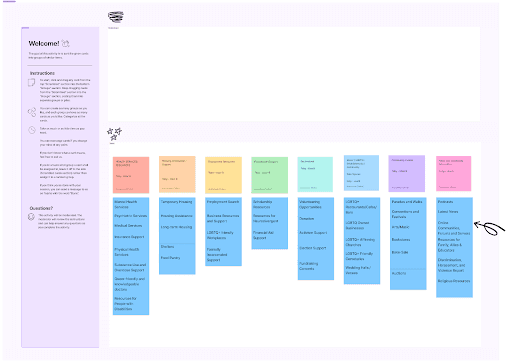
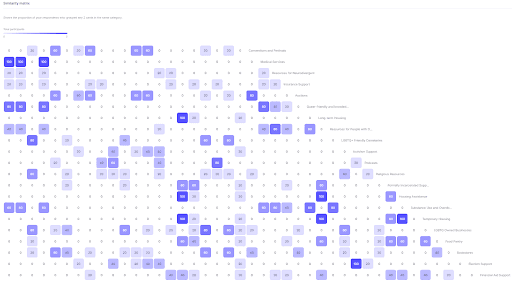
Based on the social media analysis resource categories I identified, we set out to conduct an open card sorting session where we wanted to understand where the users themselves would expect to find resources.
We conducted this with 6 members of the community who were stakeholders of Atlanta Pride too.
We also conducted tree testing with 8 potential users and HCI professionals to validate the structure. Analyzing it, we identified the resource categories that allowed us to structure the Information Architecture.
Co-ideation Session
Our next step was to conduct a co-ideation session to truly embody the participatory design model we found from the literature review. We recruited 5 participants who have UX and website development knowledge (including us) but MOST IMPORTANTLY were ones who were part of the community as well.
We then built out an impact-effort matrix to identify the features we needed to focus on.
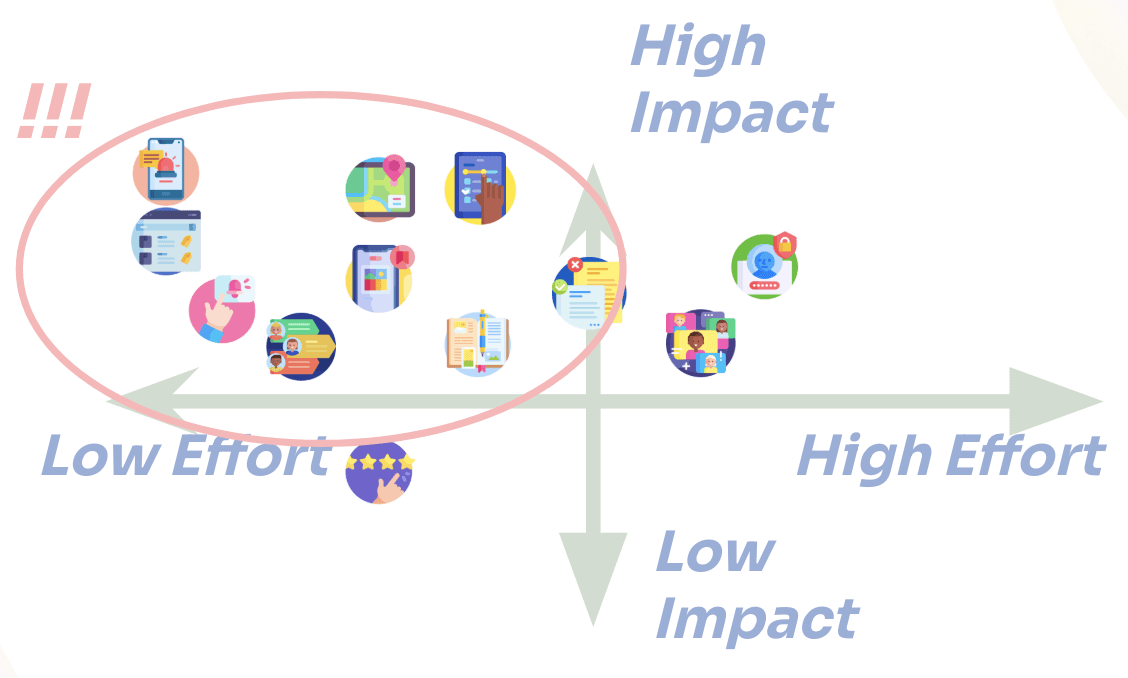
Features to focus on:
Safety / Emergency Code
Tags
Subscription / User Feed
Authority Testimonials
Save / Bookmark Resources
Interactive Map
Filters and Search
Track Record / Past Events
Comparison of Resources
Community Reviews
Sketching & lo-fi prototyping
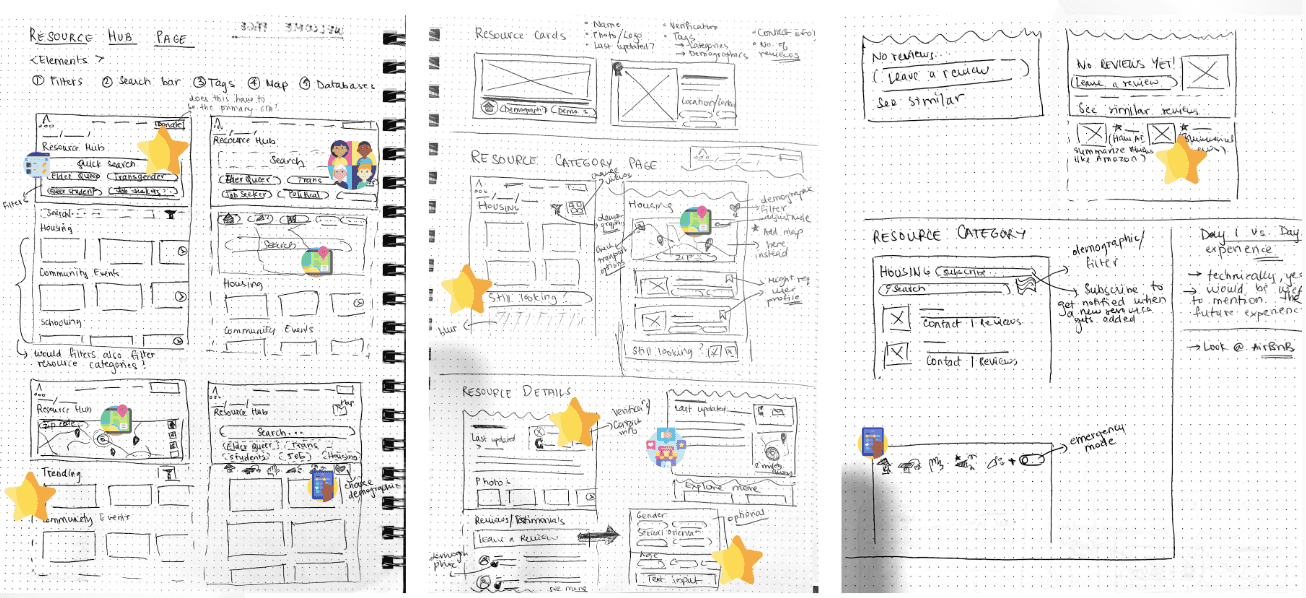
I finally started making sketches and sought feedback from one of our mentors. Following this, I quickly mocked up lo-fi wireframes and held a quick usability testing session with 4 participants which allowed me to design the hi-fi prototypes.
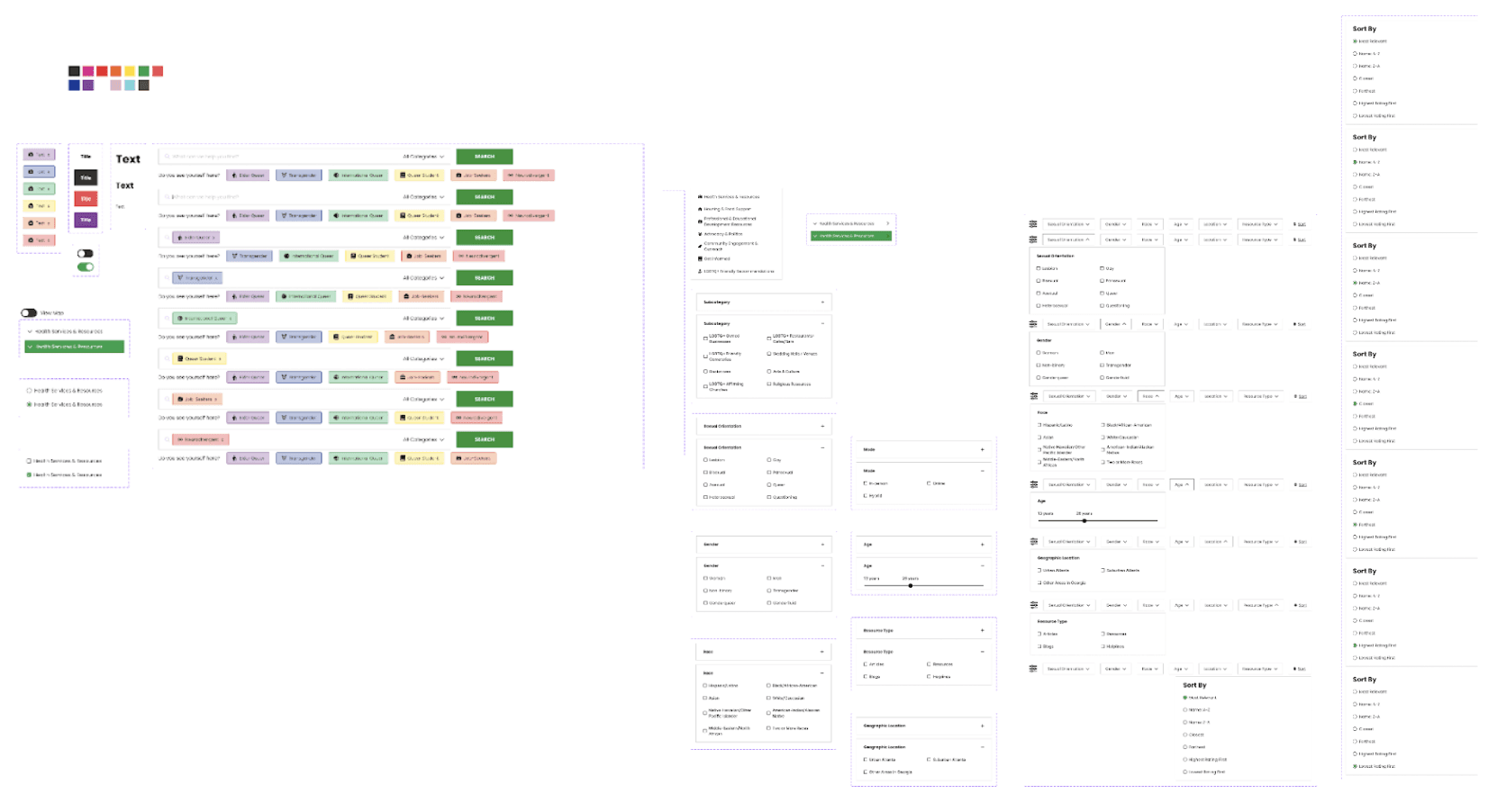
Design systems, hi-fi prototyping and heuristic evaluation
I then started building out the design system where I created over 30 components, each with a set of variations while maintaining the Atlanta Pride branding. Talking to the developers of the Atlanta Pride team, I also learnt that their website is currently being maintained on WordPress based on which I restricted the component library.
Although the website seems to embody multiple "Primary Colors", I chose to use their Green signifying growth, unity and harmony. Additionally, as this is a given I also ensured the system met WCAG standards.
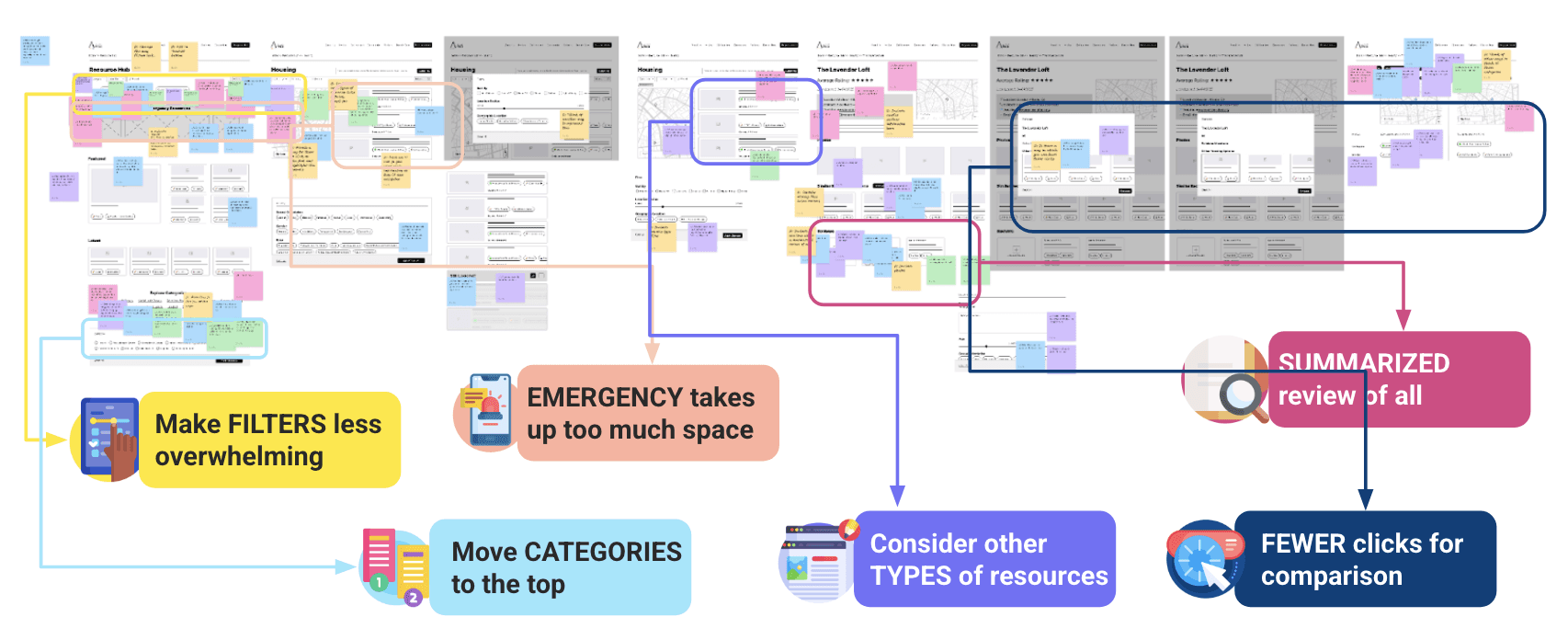
After building out the hi-fi prototypes, we conducted a usability testing round 2 and a set of heuristic evaluation sessions. Some of the things our users really liked and got a high rating were in the following domains of our prototypes.
Liked Credential of Resources
Liked the identity-based filtering

Liked the reviews with identity.
Some improvements were needed to be made in the following categories.
Improve Terminology & Categorization
Enhance Resource Grouping
Strengthen System Feedback
FINAL PROTOTYPE
After the final rounds of iterations, I worked on designing the final prototype that you can interact with below.
REFLECTION
This project taught me that inclusion starts at the information layer, long before it reaches the interface. Working with the Atlanta Pride community reminded me that "Product Design" is often about creating a sense of belonging. By structuring information to mirror lived experiences, we didn't just build a hub; we built a bridge to safety and support. It strengthened my belief that the most powerful systems are the ones that make users feel seen.
Check out my other work below: